
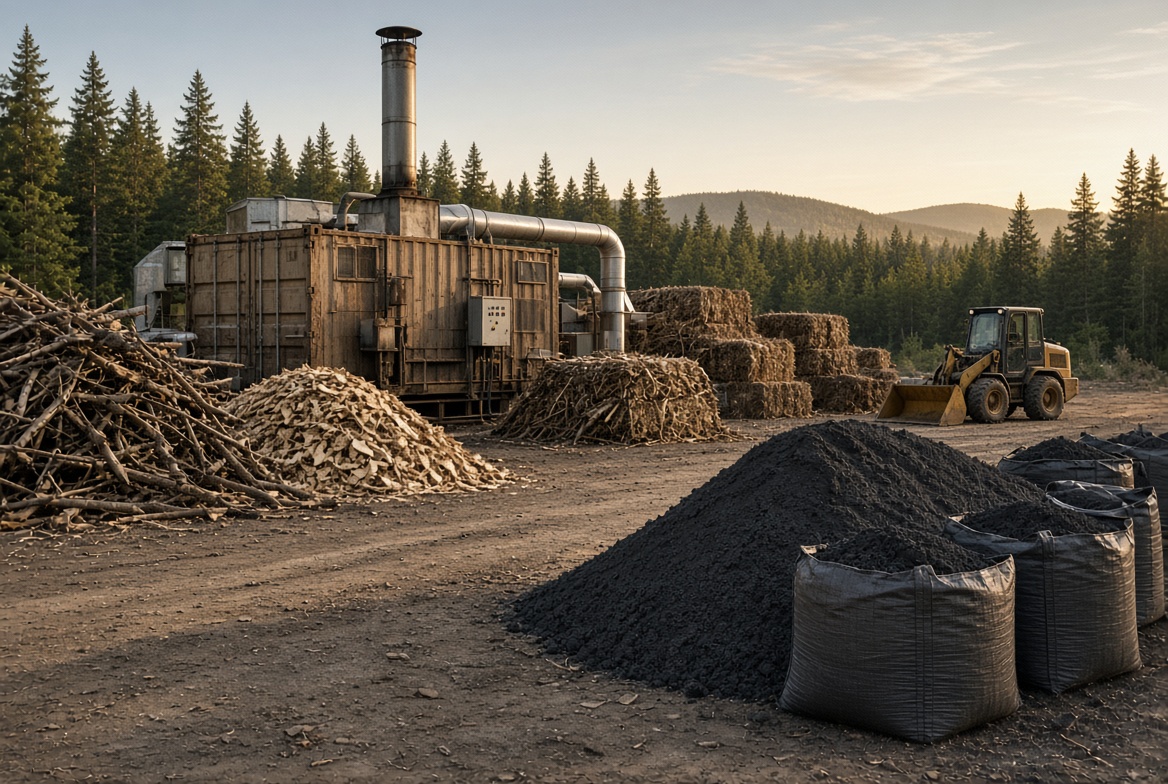
Biochar in one paragraph (so the risk map makes sense)
Biochar is the solid carbon left after biomass is heated with little or no oxygen (pyrolysis or gasification). Done well, it is stable for centuries, raises soil water-holding capacity, can cut fertilizer demand, and can generate durable carbon-dioxide-removal (CDR) credits. Done poorly, a batch fails lab specs, a kiln goes down mid-contract, a neighboring landowner alleges runoff or dust harm, or a registry later questions the tonnes you already sold.
U.S. demand is no longer theoretical. The U.S. Biochar Initiative’s first unified lab-testing protocol is now an American National Standard—ANSI/ASABE/USBI S668 (November 2025)—with additional production and safe-use standards advancing in 2026. USDA NRCS Conservation Practice Standard 336 (Soil Carbon Amendment) is the main cost-share on-ramp for on-farm use, with tens of millions already obligated across adopting states. County-scale plants (wildfire residuals in the West, rice hull and other ag residues in the South) and industrial biocarbon projects are moving from pilots to construction.
That is the opportunity. The insurance question is whether your policy language was written for a kiln, a pile of slash, a lab certificate, and a neighbor’s well—or for a gift shop and an office.
The value-chain risk map (this is what generic policies do not see)
Treat biochar as four linked operations. Coverage has to follow the material.
1. Feedstock and inbound logistics
Forest slash, mill residuals, nut shells, rice hulls, orchard prunings, biosolids, or manure solids. Risks: contamination (treated wood, plastics, heavy metals, PFAS), moisture swings that wreck energy balance, wildfire or flood destroying staged piles, trucking claims, and contract shortfalls when a timber sale or mill shuts off supply.
Typical gap: A commercial property form may cover a building. It often does not treat outdoor biomass piles, seasonal satellite yards, or “your product is unsaleable because the inbound load was contaminated” as a clean claim.
2. Conversion (the kiln, retort, or gasifier)
Incomplete pyrolysis, temperature excursions, refractory failure, explosion or fire at the unit, emissions or odor complaints, operator injury, and batch loss after hours of runtime. Scaling from a Kon-Tiki or containerized unit to a commercial plant adds builders risk, delay, and commissioning risk.
Typical gap: Equipment breakdown and inland marine (tools/equipment that move between sites) are frequently missing. Builders risk is a separate form and is easy to forget until steel is on the pad. Standard CGL also carries pollution exclusions that can gut coverage for smoke, ash, process water, or alleged contamination from the unit itself.
3. Quality, storage, and the certificate
S668 and buyer specs look at H:C ratio and fixed carbon (permanence), PAHs, metals, dioxins, PFAS where relevant, pH, salinity, nutrients, particle size, and moisture. A failed test can strand a batch, delay a carbon issuance, or force a re-run. Storage can re-wet or contaminate finished char.
Typical gap: “We have product liability” is not the same as “we are covered if the lab result kills the carbon issuance or the NRCS 336 payment.” Quality failure is often a first-party economic loss, not a third-party injury claim.
4. Application, offtake, and neighbors
Broadcast or incorporated into farm soil, blended into compost, used in stormwater media, mixed into asphalt or concrete, or sold as biocarbon. Third parties can allege yield loss, water-quality harm, dust, or “you told us this met the spec.” If you also run education days, volunteer packing lines, or demonstration plots, you have premises and volunteer exposure.
Typical gap: Application advice can be treated as a professional service. CGL is built for bodily injury and property damage, not for “your recommendation cost us a season.” Environmental claims on neighboring land or water are exactly where pollution exclusions bite.
Carbon-credit non-delivery, reversal, or invalidation after issuance is a fifth layer. That layer is often insured by specialist carbon carriers (for example, credit-warranty products used on some U.S. biochar offtakes). It protects the buyer of the tonne, not the operator of the kiln. You may need both. You should not buy one and assume you bought the other.
What Conservation United’s Biochar Insurance is built to do
Conservation United has specialized in conservation and restoration accounts since the mid-2010s—prescribed fire, trail and habitat contractors, land trusts, municipal conservation crews, and related nonprofits. Biochar sits in that same underwriting world: mobile crews, outdoor operations, mission-driven boards, grant and agency contracts, and activities that ordinary small-business packages exclude or silently limit.
The Biochar Insurance offering is customized rather than sold as a one-page commodity. In practice, programs for U.S. organizations are built around some combination of:
Production and operational risk. Incomplete pyrolysis, feedstock contamination, equipment breakdown, weather delay, and disruptions that ruin a batch or slip a verification window.
Liability and environmental safeguards. Third-party claims tied to application or operations affecting neighboring land, water, or ecosystems—including scenarios where the organization believes it followed protocol. This is where pairing the account with environmental insurance and a correctly endorsed general liability form matters.
Facility and scaling support. Construction and delay exposures on new plants, project-specific risk as you move from pilot to commercial throughput, and market volatility that hits contracted volumes. New builds should be reviewed for builders risk before groundbreaking, not after the first delay notice.
Flexible add-ons that match how conservation groups actually operate. Inland marine / equipment, workers’ compensation (including field crews), commercial property, commercial auto, and directors and officers for boards that sign carbon or offtake contracts.
Coverage is described as available to U.S.-based organizations and scalable from on-farm pilots to multi-ton commercial facilities. Limits, deductibles, and form language are account-specific. Request a quote rather than treating any blog list as a binder.
2026 standards that change underwriting and contracts
Underwriters now have a shared language. Use it in your application packet.
-
ANSI/ASABE/USBI S668 — recommended methods for measuring and testing biochar (proximate/ultimate analysis, permanence indicators, physical properties, environmental contaminants including PAHs, PCBs, dioxins, PFAS and metals, plus agricultural parameters). A documented sampling and lab program is no longer optional if you sell into carbon or agency markets.
-
Additional USBI / American Biochar Institute standards in 2026 — production consistency and safe-use work is underway. Expect buyers to write those into contracts as they finalize.
-
NRCS CPS 336 — the practice standard that lets producers cost-share soil carbon amendments, including biochar that meets stated criteria. Failed specs can delay or deny a payment even if the char is “good enough” for a local garden plot.
-
Registry methodologies (Puro.earth, Verra, and others used for BCR) — permanence, leakage, and MRV language that can invalidate credits after the fact if application or documentation slips.
Insurance does not replace a lab. It funds the consequences when a documented process still produces a bad batch, a delay, or a third-party claim.
Who should put this on the board agenda this quarter
On-farm and ranch producers running a kiln as a sideline to timber, orchard, or livestock operations. You likely already have a farmowner or ranch package. Ask, in writing, whether pyrolysis equipment, staged biomass, finished inventory, and custom application on other people’s land are covered or excluded.
Cooperatives and county facilities (the Colorado wildfire-residual model, Southern ag-residue plants). Construction, public-entity additional-insured requirements, and feedstock contracts with timber or mill partners all need coordinated certificates.
501(c)(3) education and market-development groups that demonstrate kilns, host volunteer packing days, or advise growers. Premises liability, volunteer accident, and professional advice are the three places nonprofit packages usually thin out. D&O belongs in the same conversation once staff start signing MOUs.
Research and university-affiliated pilots moving off-campus onto working lands. Site access agreements will demand specific additional-insured and waiver language.
Organizations that already buy prescribed fire or forestry coverage from Conservation United. Biochar is often the next use of the same biomass you would otherwise burn or chip. Crews, trucks, and landowner relationships overlap. Align the biochar schedule with your nationwide prescribed fire liability program so a single season of fuel-reduction work is not split across contradictory exclusions (especially hostile-fire language on ordinary GL forms).
What to send when you request a quote
Underwriters price what they can see. A complete packet shortens the cycle and reduces “we excluded that because we didn’t know it existed.”
-
Entity type, states of operation, and whether you are U.S.-only.
-
Feedstocks, annual bone-dry tons, and whether any feedstock is biosolids, manure, or treated wood.
-
Technology: kiln/retort/gasifier make, age, throughput, fixed vs. mobile, and whether you operate on owned land, leased land, or landowner sites.
-
End uses: on-farm soil, wholesale ag, compost blend, stormwater, asphalt/concrete, animal bedding, or CDR credits (name the registry if any).
-
Lab program: S668 (or IBI/EBC) tests, frequency, and who pays for failed-batch retesting.
-
Contracts: offtake volumes, carbon forward sales, NRCS 336 involvement, public-entity additional insureds.
-
People: W-2 staff, 1099 operators, volunteers, and whether you need workers’ comp in multiple states.
-
Property schedule: buildings, kilns, mobile equipment, inventory (feedstock and finished), and any construction in the next 12 months.
-
Loss history and any pending neighbor, odor, or smoke complaints.
-
Current policies and the exclusions you already know about (pollution, professional, hostile fire, biomass in the open).
Start at Request a Quote or call 1-855-570-2797. Conservation United’s conservation desk is set up for this kind of operation; a generalist agent will often try to force-fit a BOP.
How this should sit next to the rest of your Conservation United program
Do not treat “biochar insurance” as a replacement for the core commercial stack. Treat it as the specialty layer that makes the stack honest.
-
Injury to a kiln operator or field applicator → workers’ compensation
-
Visitor or neighbor bodily injury / property damage → general liability
-
Smoke, leachate, alleged contamination → environmental insurance
-
Building, silo, or finished inventory at a fixed site → commercial property
-
New plant under construction → builders risk
-
Board decisions on carbon contracts and grant compliance → directors and officers
-
Same crew doing pile burning or broadcast burns on the way to a biochar yard → prescribed fire program, not a standard CGL
Risk management support—documented SOPs, training logs, sampling protocols—does as much to keep you insurable as the policy form itself.
A realistic (composite) operating picture
A West Slope nonprofit partners with a county and a sawmill. Slash that used to sit in burn piles moves to a containerized pyrolysis unit. Finished char goes three ways: vineyard trials, a municipal stormwater pilot, and a small CDR issuance.
Without specialty review, the nonprofit’s package would likely: cover the office; maybe cover the container if scheduled; exclude or limit pollution from the unit; leave volunteers on demonstration days in a gray area; and say nothing useful if a lab result strands 40 yards of product the week before an NRCS-related delivery.
With a Conservation United structure, the conversation is different: the unit and inventory are scheduled, environmental and application liability are addressed on purpose, workers’ comp and auto follow the crew between the mill yard and the vineyard, builders risk is bound before the pad is poured for year-two capacity, and the board’s D&O sits over the carbon contract. Credit-warranty insurance, if the buyer requires it, is purchased as a separate conversation with a CDR specialist—not treated as a substitute.
That is the difference between “we have insurance” and “we can sign the landowner access agreement.”
Practical takeaways
-
Buy operational coverage for the kiln, the crew, the neighbor, and the batch. Buy credit warranty only if you sell tonnes and the buyer requires it.
-
Read the pollution and professional-services exclusions on your current CGL before you assume application and emissions are covered.
-
Put S668 sampling and NRCS 336 spec sheets in the underwriting file. They are now part of how U.S. biochar risk is described.
-
If you already run prescribed fire, forestry, or trail crews with Conservation United, add biochar to that relationship instead of opening a second generic account.
-
Quotes are custom. The fastest path is a complete packet through conservationinsurance.com/request-quote.
Conservation United’s job is the same here as on a burn unit or a restoration site: keep mission-driven operators from discovering a silent exclusion after the loss. Biochar is mature enough that the exclusions are knowable. The organizations that scale in 2026 will be the ones that insured the process, not just the press release.
Protect the operation, then scale the market. Request a Biochar Insurance review at conservationinsurance.com or call 1-855-570-2797.


