Trail Maintenance & Construction Insurance: The Coverage Stack Land Managers, Grantors, and Volunteers Actually Need
Most trail projects do not fail because the crew cannot build a durable tread. They fail in email.
A forest district asks for a certificate that names the United States as additional insured, includes products/completed operations, and shows $1 million per occurrence. A state Recreational Trails Program (RTP) agreement wants workers’ compensation plus auto. A private landowner who allowed a connector across a ranch wants proof that a weekend volunteer day will not become their problem. A grant reimbursement sits until the certificate matches the contract—not “close enough.”
That is the job of Trail Maintenance & Construction Insurance from Conservation United: a coverage stack built for organizations that design, build, repair, and steward trails, not for offices that occasionally “do some outdoor work.”
Conservation United is a conservation-focused brokerage (not a generic Main Street agency). The team has spent years placing risk for trail alliances, land trusts, parks partners, mountain-bike organizations, conservation corps, and OHV groups, and has worked with field partners such as American Trails and the Society for Ecological Restoration. Policies are placed with A.M. Best A-rated carriers and are available in all 50 states.
If you only need a small general-liability layer for light stewardship, start with TrailsUnited. If you are cutting new alignment, setting stringers, running a mini-excavator, or signing a land-manager agreement, you need the construction stack below.
Why a “regular” policy quietly drops trail work
Generic commercial general liability is written for premises and routine operations. Trail work is neither.
Underwriters who do not live in this world often treat chainsaws, rock work, sidehill benching, puncheon and bridge assembly, winch use, mechanized tillers or compact excavators, and public traffic through an active corridor as construction—then attach the exclusions that come with construction. Common gaps we see when a trail group brings in a policy written by a non-specialty agent:
-
Volunteer medical is missing. Unpaid crew members are usually not employees. Workers’ compensation does not automatically pick them up. A “volunteer waiver” is not a medical policy and does not stop a third-party lawsuit.
-
Your work / completed operations is weak or excluded. A drainage failure six months after the ribbon cutting is a design-and-construction problem, not a slip-and-fall on your office walk.
-
Tools are insured at the shop, not on the mountain. A BOP “business personal property” limit does not follow a Sweco, rock drill, or trailer-mounted compressor up a two-track.
-
Design is uninsured. If your organization both draws the alignment and builds it, a GL-only policy does not answer an errors-and-omissions claim about grade, drainage, or accessibility.
-
Additional-insured endorsements are wrong. Land managers routinely want CG 20 10 plus completed-operations language (often CG 20 37 or equivalent), not a blanket sentence that looks good in an email.
-
Pollution and sediment are assumed away. Hydraulic fluid, treated lumber, or a sediment pulse into a listed stream is not “general liability” in every form.
-
OHV and mechanized access get a surprise exclusion. Motorized stewardship and motorized-route maintenance are not the same risk as a hiking club work day.
If any of those sound familiar, the policy was written for a different business.
The coverage stack, explained the way a field supervisor thinks
1. General liability — the work zone and the public
This is the policy land managers ask for first. It responds when a hiker walks through an active corridor, a cut tree tags a parked truck at the trailhead, or a temporary closure is alleged to have been signed poorly.
Ask for more than “$1 million.” Confirm:
-
Occurrence form, not claims-made, for operations
-
Products and completed operations
-
Blanket additional insured and the specific wording in your special-use permit or grant
-
Primary and noncontributory language if the agency requires it
-
Waiver of subrogation if the contract requires it
-
No exclusion for work on public land, volunteer labor, or “construction” that would swallow trail building
Related reading: General Liability Insurance.
2. Volunteer accident medical — the coverage most boards skip
Volunteers are the labor model for American trails. They are also the people most often left off the policy.
Volunteer accident medical pays medical bills for an unpaid person hurt on a work day—rolled ankle on talus, saw kickback, heat illness—without first arguing whether that person was an “employee.” It does not replace general liability (a visitor’s lawsuit) and it does not replace workers’ compensation (paid staff).
If your organization runs Saturday work days, youth crews, or corporate volunteer events, this is not a luxury endorsement. It is how you keep a medical bill from becoming a board crisis.
3. Workers’ compensation — paid hands, even seasonal ones
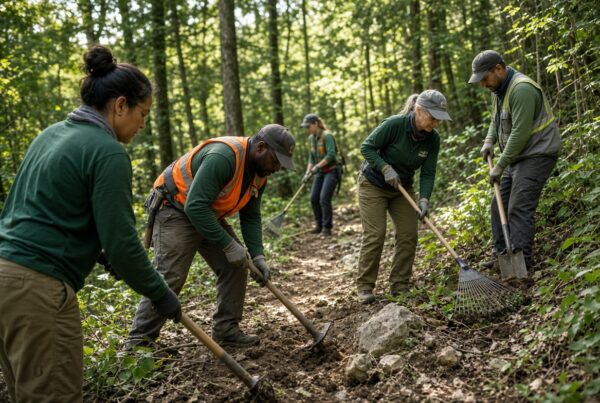
Crew leaders, conservation-corps members, contractors you hire as employees, and anyone you control like staff belong on workers’ compensation. Trail injuries cluster around cutting tools, lifting rock, uneven footing, and machines. State law, not your volunteer handbook, decides who is an employee.
A practical rule: if you can direct the person’s work, set their hours, and they are paid, assume workers’ comp until counsel or the carrier says otherwise.
4. Professional liability (E&O) — when you designed the line you are building
Drainage that concentrates water, a grade that fails in the first monsoon, a structure that does not match the permit drawings, an accessible route that does not meet the standard you implied—those are professional claims.
The Nationwide Trail Insurance Program exists because design/build is now normal in this industry. GL and E&O in one program, written for trail builders, is cleaner than bolting a generic consultants policy onto a contractor GL form.
5. Equipment and inland marine — the saws, the machine, the trailer
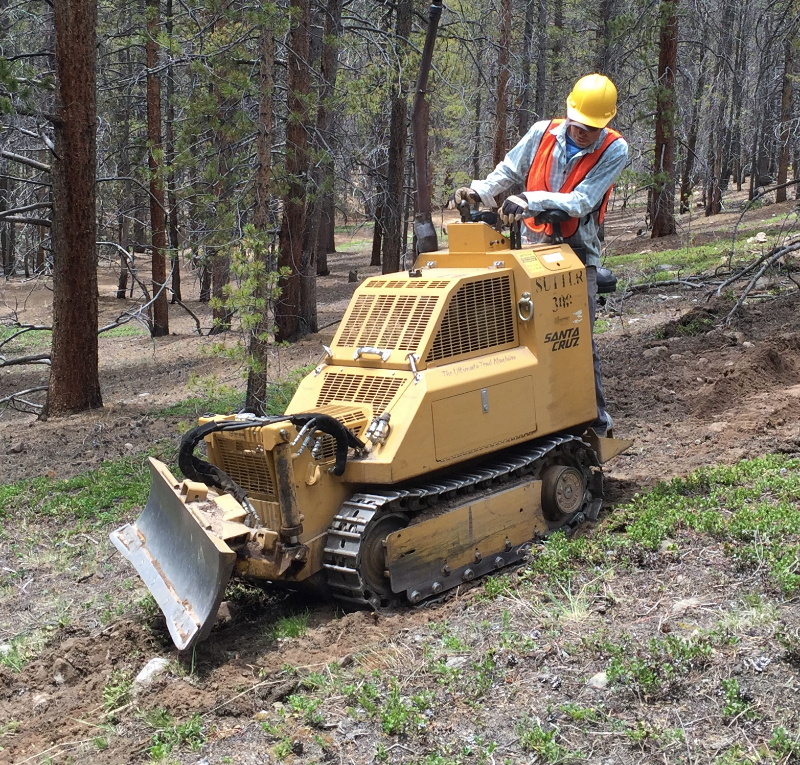
“Inland marine” is the unglamorous name for coverage that follows tools away from a building: pulaskis and rock bars, battery saws, generators, GPS and tablets, trailers, compact excavators, trail dozers, groomers.
Schedule the items that would stop a season if they disappeared. Photograph serial numbers. Say so if gear overnights in a remote connex or on a trailer at a trailhead. Shop theft and ridgeline theft are different conversations with a carrier.
6. Environmental / pollution options
Trail work is conservation work, which is why a sediment or fuel claim feels especially bitter. If you use hydraulic machines near water, treat wood in wet sites, or disturb soils in sensitive habitat, ask whether a pollution or contractors-pollution option belongs on the same program. Pair this with prescribed fire coverage when corridor work includes fuel reduction.
7. Surety bonds — when the contract will not move without one
Public owners and some grantors require a performance or payment bond before a larger build. Insurance pays claims. A bond guarantees the work gets finished or labor and materials get paid. Conservation United places trail-related surety so the insurance conversation and the bond conversation happen with people who already understand the job.
8. The rest of the organization
Trail projects do not live alone. Boards still need directors and officers liability. Crew trucks need commercial auto. A tool cache or visitor kiosk needs property coverage. An umbrella is often cheaper than discovering a $1 million grant contract expected $2 million.
What land managers and grantors put in writing
You do not need to memorize every state RTP manual. You do need to read the insurance exhibit before you bid or accept the award. Patterns repeat:
-
Commercial general liability around $1 million per occurrence / $1–2 million aggregate
-
Additional insured status for the agency, and often for private landowners on the alignment
-
Completed-operations protection after the crew leaves
-
Workers’ compensation as required by state law
-
Automobile liability when the project uses vehicles (often $1 million combined single limit)
-
Certificate delivered before work, not after the first work day
-
Sometimes primary/noncontributory wording and a waiver of subrogation
Michigan motorized-trail grants, Colorado Parks and Wildlife trail contracts, and many federal volunteer agreements all orbit that same list. The organization that can produce a clean certificate in a day or two is the organization that keeps the season.
Bring the exhibit—not a summary of it—when you request a quote. Matching an endorsement is faster than discovering a mismatch after a ranger has already locked the gate.
Five field scenarios (and which coverage should answer)
1. A hiker ignores flagging and walks into a rock crew.
General liability. Signage and a safety tailgate reduce the odds; they do not replace the policy.
2. A volunteer ruptures an Achilles setting a stone step.
Volunteer accident medical for the hospital bill. GL if the person later alleges the organization ran an unsafe site. Workers’ comp only if that person was actually an employee.
3. A rented mini-excavator is vandalized at a remote staging area overnight.
Inland marine / equipment—if the machine was scheduled or the rented-equipment limit is high enough, and if overnight off-premises storage was disclosed. Not GL.
4. The new puncheon sheds water onto a neighbor’s drive the following spring.
Completed operations under GL, and possibly professional liability if the design is the issue.
5. An OHV club’s trail-day winchline scars a private fence on an access road.
GL under a program that actually contemplates motorized stewardship, not a hiking-club form with a motorized exclusion.
Write your safety plan for these five. Then buy the coverage that maps to them.
A 30-minute pre-project insurance checklist
Print this. Attach it to the project folder with the permit.
-
Who owns the land, and whose name must appear as additional insured?
-
Is this maintenance of an existing tread, new construction, or design/build?
-
Will the public remain on the corridor during work?
-
Paid crew, volunteers, contractors—or all three in one week?
-
What tools and machines leave the shop, and where do they sleep?
-
Bridges, cribbing, blasting, hot work, or work within a railroad or highway right-of-way?
-
Water, wetlands, or listed species in the disturbance footprint?
-
Grant or contract insurance exhibit attached (limits, endorsements, bond)?
-
Certificates needed for landowner, agency, and funder—or only one of them?
-
Who calls Conservation United if the certificate is rejected on a Friday afternoon?
If you cannot answer 1, 4, 8, and 9, you are not ready to advertise the work day.
How Conservation United runs the quote
This is a brokerage conversation, not a web-form lottery.
-
Smaller organizations often complete a short questionnaire (on the order of 20 questions) and see a response the same day.
-
Larger or multi-state builders typically turn around in one to two business days.
-
Short-term project policies are commonly available without the collateral some surety or construction markets demand.
-
Claims and risk-management support are handled by people who already know what a McLeod is.
Start here: Request a Quote or Contact Conservation United.
Have ready: organization type, states of operation, paid vs. volunteer headcount, a one-paragraph project description, equipment list, and the insurance page from the permit or grant.
Frequently asked questions
Is a signed volunteer waiver enough?
No. A waiver may help on a first-party claim by that volunteer. It does not pay their emergency-room bill by itself, and it does not stop a claim by a visitor or adjacent landowner.
We only rehab existing trail. Do we still need “construction” insurance?
If you change drainage, rebuild structures, reroute failed segments, or use mechanized equipment, land managers will treat it as construction for certificate purposes. Call it maintenance in the newsletter; insure it as the work it is.
Can one policy cover hiking, mountain-bike, and OHV work?
Sometimes, if the form is written that way. Do not assume a non-motorized friends-group policy extends to motorized route work. Ask.
Will this satisfy a USFS or state parks volunteer agreement?
That is one of the main reasons the program exists. Send the agreement. The certificate should track the exhibit, not a generic template.
How is this different from TrailsUnited?
TrailsUnited is an accessible GL starting point (publicly described as starting at $500 a year) for lighter trail-organization liability. Construction, design/build, heavy equipment, and grant-driven builds need the broader stack in this article.
Get the project to dirt, not to a coverage argument
Trails stay open because someone shows up with tools, a plan, and a certificate the land manager can accept. Conservation United’s Trail Maintenance & Construction Insurance is built for that third item—so the first two can do their job.
Request a quote · Talk to the brokerage · Learn about Conservation United