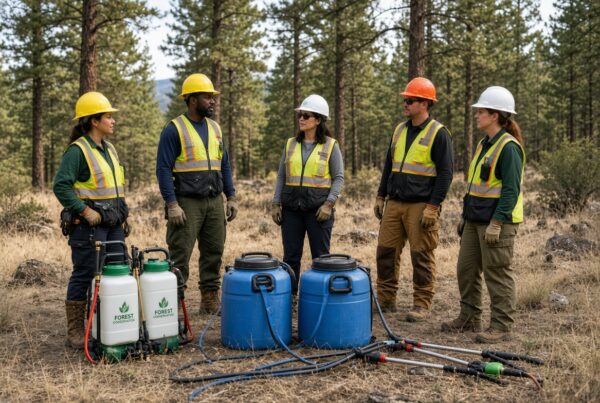
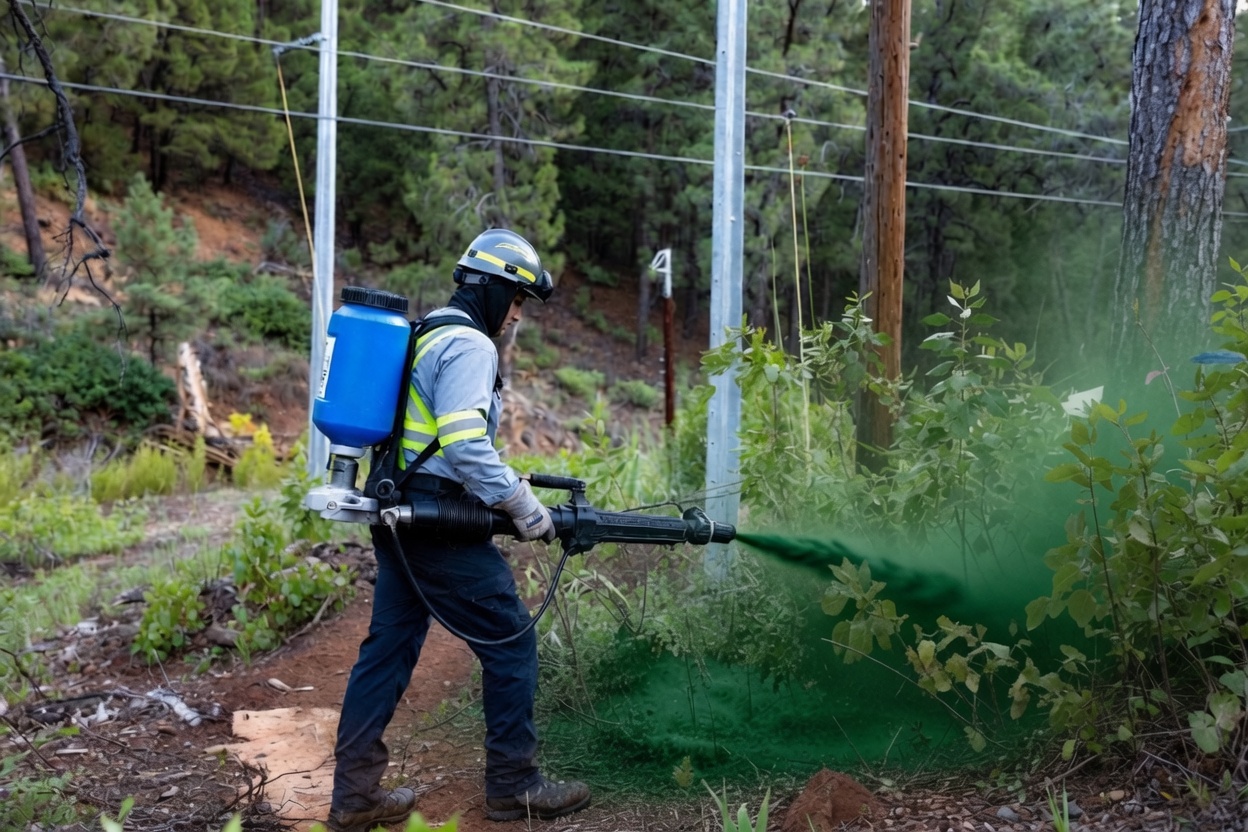
This is not homeowner wildfire-defense service. It is the policy the applicator has to carry.
If you searched “wildfire defense insurance,” you may have landed on pages about carriers that send private crews to wrap a policyholder’s house in gel when a fire is three miles out. That is a homeowner loss-prevention endorsement. It is not what a land trust, municipality, timber manager, or HOA asks an applicator to produce.
What they ask for is a certificate that names three coverages on one placement:
-
General Liability for the day you are on the property with hoses, tanks, and crew
-
Professional Liability (Errors & Omissions) for the prescription you wrote
-
Pollution Liability for the product that is now on living vegetation, soil, and — if the wind shifted — a neighbor’s fence line
Conservation United built Wildfire Defense Insurance for that certificate. The program is written for professional applicators and conservation contractors using Komodo Fire Systems products (including K-101 Perimeter Shield) and other long-term or short-term retardants. It is available nationwide, placed with carriers that already understand conservation and environmental risk, and structured so spraying, advising, and alleged environmental harm do not fall into three different exclusion gaps.
As of late September 2026, the National Interagency Fire Center had recorded tens of thousands of U.S. wildfires and more than 8.5 million acres burned year-to-date. That volume is why pretreatment work is growing. It is also why contract language has tightened. Clients who used to accept “GL $1M” now ask whether pollution is excluded, whether professional services are excluded, and whether the class code treats you as a pesticide applicator.
Why a standard CGL policy fails the job — even when the product is plant-based
A Commercial General Liability form was written for contractors who install or maintain physical things. Fire-retardant work is different. A crew mixes a formulation, applies it to living vegetation and combustible structures, leaves a residual barrier in place, and often recommends rates, buffers, and reapplication after rain. That combination creates three claim paths. A generic CGL usually answers only the first, and even then with exclusions that can swallow the claim.
Path 1 — Operations injury and property damage.
A visitor slips on a wet spray line. A hose burst stains a vehicle. A backpack sprayer knocks a client off a porch. A pump trailer rolls into a trailhead gate on a land-trust parcel. These are CGL events — if the form was not written with a hostile-fire limitation or a class code that treats the work as uninsurable fire service.
Path 2 — Professional error.
Nobody was hurt on spray day. Six weeks later a landowner alleges the prescription was negligent: wrong product, wrong mix, wrong weather window, a skip-spray around a seasonal drainage that should have been treated, or a decision not to retreat after a two-inch rain. That is not a products claim against the manufacturer. It is a claim against the person who chose the protocol. A professional-services exclusion on a standard CGL drops coverage the moment a written recommendation goes out.
Path 3 — Alleged environmental harm.
Drift onto a neighbor’s orchard. Runoff into a seasonal creek. Staining. An inspector flags “contamination.” A total pollution exclusion on CGL bars defense and indemnity regardless of how green the SDS reads. Plant-based does not equal pollution-exclusion-free. Underwriters and opposing counsel treat applied chemical as pollutant unless a dedicated pollution form is on the placement.
Komodo’s K-101 Perimeter Shield is a useful example of why the distinction matters. It is a plant-based, water-diluted powder applied as a passive perimeter retardant. Komodo states the product has passed USDA / U.S. Forest Service tests for burn performance, mammalian and aquatic toxicity, corrosion, and stability, and is intended to remain in place unless washed by prolonged rain. That safety profile helps underwriting. It does not delete the pollution exclusion on a contractor’s off-the-shelf CGL. The claim is about application into an environment, not about whether the formula is ammonium phosphate or food-grade minerals.
What Conservation United’s Wildfire Defense Insurance actually puts on the certificate
Policies are customized to field operations, equipment, states of work, and the limits clients write into contracts. The core stack is the part procurement officers look for first.
1. General Liability (CGL)
Covers bodily injury and property damage arising from field operations, equipment use, site access, and application. That includes work on remote conservation parcels, land-trust properties, near public trails, adjacent to homes in the wildland-urban interface, and in partnership with youth corps or prescribed-fire crews.
What a properly structured CGL should not do on this class: treat retardant application as a pesticide operation by default, apply a blanket hostile-fire limitation that restricts fire-adjacent pretreatment, or leave site-access damage (gates, fences, irrigation, ornamental plantings) in a gray zone.
Typical triggers Conservation United prices as the intended risk, not as an exception:
-
Crew movement on slopes, roofs, and uneven ranch roads
-
Mix-and-load at a trailhead or ranch shop
-
Overspray onto vehicles, decks, or neighboring ornamentals
-
Equipment contact with gates, fences, and irrigation
-
Work alongside other contractors during a bundled hardening + pretreatment job
2. Professional Liability (Errors & Omissions)
Protects against claims that a site assessment, treatment recommendation, application plan, or advisory service was negligent — even when no one was injured during the job.
This is the coverage most applicators discover they do not have after they start winning land-trust and municipal work. Those clients do not just want product on vegetation. They want a written scope: which zone, which product, which rate, which buffer from water, which reapplication trigger after rain. The moment that scope exists, professional-services exposure exists.
E&O is not a substitute for the manufacturer’s product liability. It covers your judgment:
-
Product selection (Komodo K-101 vs. another long-term retardant vs. a short-term suppressant)
-
Mix ratio and coverage rate for the fuel type in front of you
-
Weather-window and wind-cutoff decisions
-
Skip-spray decisions around drainages, organic gardens, or listed habitat
-
Advice that a perimeter “meets” a client’s defensible-space specification
-
A decision not to retreat after rainfall
Pairing E&O with CGL is what keeps advice and application from being argued into two different exclusions.
3. Pollution Liability
Responds to claims involving alleged environmental impact from application: drift, runoff, soil or water concerns, staining, or third-party exposure. It is built to help with defense costs, cleanup, and settlements.
Land trusts, public agencies, and habitat-restricted landowners increasingly make proof of pollution coverage a contract condition, not a preference. They have boards, funders, and conservation easements to answer to. A certificate that is silent on pollution is a certificate they cannot accept.
Conservation United works with carriers that treat modern retardants as insurable conservation tools, not as an automatic decline. Applicators who arrive with SDS sheets, written wind cutoffs, water-body buffers, spill kits, and training records are underwritten as a priced class rather than a rejected one. That is the operational difference between “we use a green product” and “we can bind pollution.”
Coverages that should travel with the three-form stack
The liability trio is the certificate. The following are the operational coverages that keep a claim from landing in an uninsured gap the day after an incident:
-
Commercial auto for pump trucks, crew trucks, and trailers
-
Tools and equipment / inland marine for sprayers, pumps, tanks, mixers, and mapping drones
-
Workers’ compensation for slopes, roofs, remote parcels, and heat
-
Surety bonds when public or grant-funded projects require security
-
Prescribed fire liability when the same organization also conducts or supports controlled burns — see Conservation United’s nationwide prescribed fire program
Bundling hardening work (vents, ember-resistant materials, defensible-space landscaping) with retardant application on one policy is available when the operation actually does both. That is a different exposure mix than spray-only work, and it should be classified that way rather than forced into a generic contractor form.
Who this program is built for
-
Professional wildfire-defense and mitigation contractors
-
Applicators serving land trusts, conservancies, and private landowners
-
Crews doing perimeter pretreatment and fuel-break work
-
Firms that combine retardant application with mechanical thinning or home hardening
-
Consultants who write site assessments and treatment prescriptions
-
Organizations working on conserved lands, trail corridors, nature-school properties, and community interface parcels
If your only product is a homeowner DIY kit sold over the counter, this is not your program. If you are the contractor a land trust, utility, or ranch manager calls in May, it is.
A 20-minute certificate audit before you bid the next land-trust job
Print last year’s certificate. Sit with the contract exhibit. Mark every line that fails.
-
Does the certificate name pollution liability, or only CGL?
-
Does it name professional liability / E&O, or only CGL?
-
Is there a professional-services exclusion on the CGL that will be used against you after you issue a written prescription?
-
Is there a total pollution exclusion on the CGL?
-
Is the class code pesticide, hazmat, or fire suppression — none of which describe pretreatment with a long-term retardant?
-
Are additional-insured and waiver-of-subrogation endorsements available in the form the land trust specified?
-
Do limits match the exhibit, including excess if they asked for $5 million or $10 million?
-
Are the states of operation listed correctly? Nationwide availability does not help if the certificate is silent on the state where the parcel sits.
-
Can you produce an SDS, application protocol, wind cutoff, and water-body buffer on the same day as the certificate?
-
If you also burn, is prescribed-fire liability on a form without a hostile-fire exclusion?
Any “no” on items 1–4 is why Conservation United’s program exists. The rest is why quotes should be built from the contract, not from last year’s binder.
What to have ready for a quote
Same-day or next-day indications are realistic when the submission is complete. Have this in one folder:
-
Legal name, years in business, entity type, states of operation
-
Services actually performed (spray only, prescription + spray, hardening + spray, support for prescribed fire)
-
Products used, starting with brand and formulation (Komodo K-101 and any others)
-
Revenue split and projected acres or jobs for the coming season
-
Largest job and the contractually required limit
-
Loss runs or a no-loss statement
-
A sample contract or insurance exhibit
-
SDS on file, wind cutoff, water-body buffers, spill kit, training records
Request a quote at conservationinsurance.com/request-quote or call 855-570-2797.
How Conservation United underwrites Komodo differently from a generic “chemical applicator” submission
Generic markets see “retardant” and reach for a pesticide or pollution-heavy class. Conservation United’s conservation-sector placement works in the other direction: document the product and the controls, then price the operation.
For Komodo and similar next-generation retardants, the file that changes a quote is not a marketing PDF. It is:
-
The SDS and the USDA / Forest Service test summary the manufacturer publishes
-
A written protocol: mix ratio, target coverage, vegetation types treated, reapplication after rain
-
Operational controls: wind cutoff, distance from open water, spill response, crew training
-
Client mix: private parcels vs. easement lands vs. municipal rights-of-way
-
Whether the crew also writes prescriptions (which pulls E&O into the same placement)
That file is also what a claims adjuster will ask for later. Building it for the quote is cheaper than building it after a demand letter.
Frequently asked questions
Is Wildfire Defense Insurance the same as the wildfire-defense service on a homeowner policy?
No. Homeowner services (often delivered by third-party crews working for a carrier) protect a specific insured house when a fire approaches. Conservation United’s program insures the contractor who pretreats land, writes prescriptions, and applies retardant for many clients.
If Komodo is non-toxic, do I still need pollution liability?
Yes. Toxicity and insurability are different questions. Pollution forms respond to alleged environmental impairment and defense costs. Land-trust contracts treat that allegation as a covered risk they require you to transfer.
Can I add prescribed fire to the same relationship?
Yes. Many mitigation firms do pretreatment and burning. Those are related but not identical forms. Conservation United places prescribed-fire liability without the hostile-fire exclusion that voids ordinary GL policies when fire is the tool. Start at the prescribed fire insurance program page.
What limits should a new applicator buy?
Buy what your contracts require, then add margin for the next larger client. $1 million closes homeowners. $2 million–$5 million is the land-trust conversation. Confirm excess availability before you promise $10 million in a proposal.
Is coverage available in California and other high-risk states?
The program is offered nationwide. Eligibility and pricing still depend on operations, product, controls, and loss history — not on a single-state embargo as a starting point.