Wildfire Defense Insurance: GL, E&O, and Pollution Coverage for Komodo and Other Fire Retardant Applicators
The work changed. Most insurance policies did not.
By late August 2026, the National Interagency Fire Center had already recorded more than 51,000 U.S. wildfires and roughly 7.9 million acres burned. That is the operating environment for every contractor who pretreats vegetation, builds chemical fuel breaks, or applies long-term retardants around homes, ranches, land-trust holdings, and community perimeters.
Demand followed the fire calendar. Landowners, HOAs, municipalities, and conservation groups now hire crews to spray plant-based products such as Komodo Fire Systems’ K-101 Perimeter Shield and other long-term retardants before ignition weather arrives. The field work is straightforward. The insurance is not.
A standard commercial general liability policy was written for contractors who install or maintain physical things. It was not written for a mobile crew that mixes a formulation, applies it to living vegetation and combustible structures, leaves a residual barrier in place, and may also recommend treatment rates or certify that a perimeter meets a client’s scope. Those activities create three claim paths—operations injury and property damage, professional error, and alleged environmental harm. Most off-the-shelf policies address only the first, and even then with exclusions that can swallow the claim.
Conservation United built Wildfire Defense Insurance for that gap. The program is for fire retardant applicators and conservation professionals, including crews using Komodo and other systems. Core policies include General Liability, Professional Liability (Errors & Omissions), and Pollution Liability, with commercial auto, tools and equipment, workers’ compensation, and surety bonds available on the same placement. Coverage is nationwide, with limits commonly scaled up to $10 million when contracts require it.
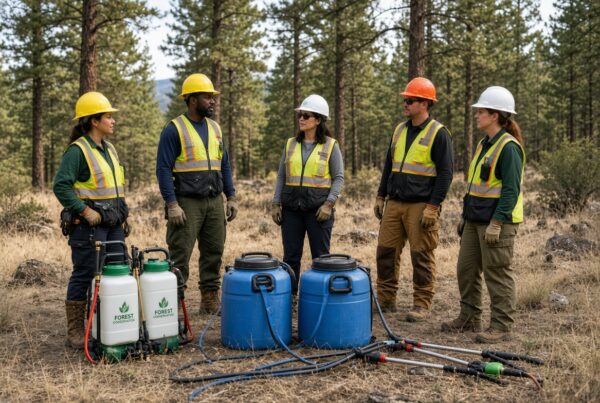
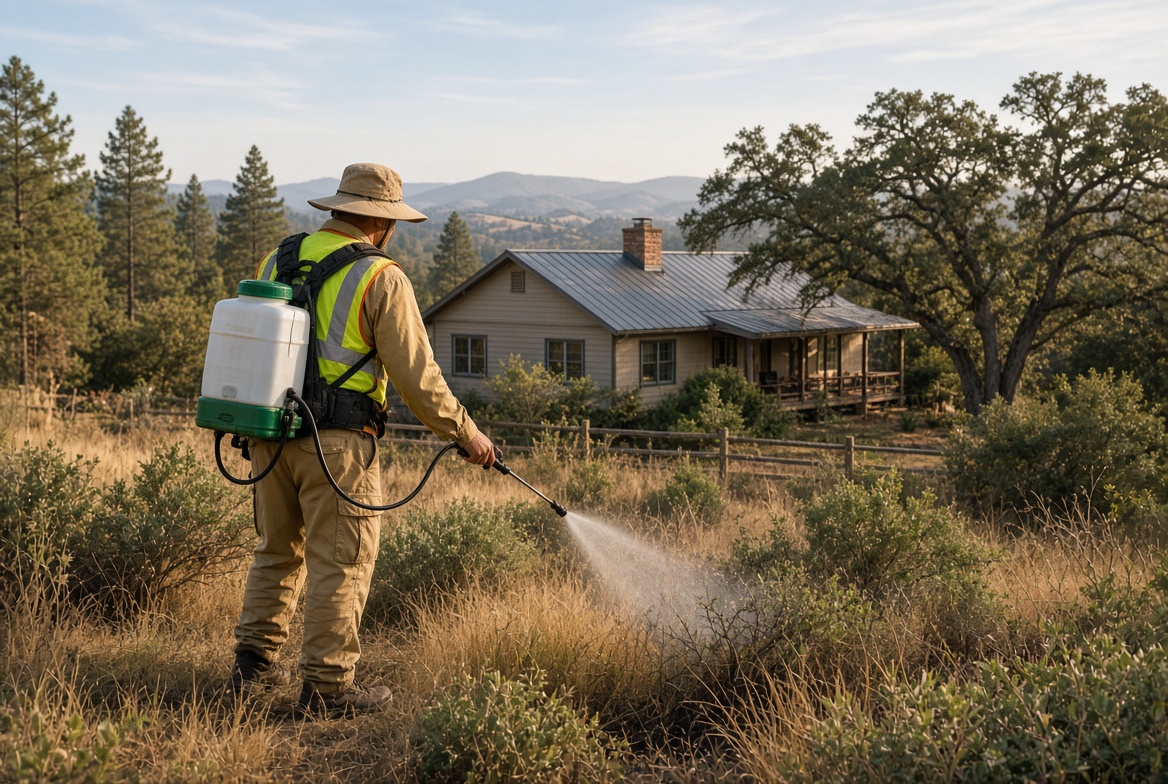
What wildfire defense looks like in the field
On a single week a crew may:
-
Pretreat home ignition zones, fences, decks, outbuildings, and ornamental plantings
-
Spray perimeters along ranch roads, trail corridors, and conserved parcel boundaries
-
Build chemical fuel breaks that support prescribed fire or mechanical thinning
-
Do just-in-time application when a fire is already on the landscape
-
Deliver written site assessments and treatment prescriptions that a landowner, insurer, or HOA will later treat as professional advice
Komodo’s formulations are plant-based and non-toxic when used as directed, and have been evaluated against USDA / U.S. Forest Service performance, toxicity, corrosion, compatibility, and stability tests for ground application. That safety profile matters to conservation clients. It does not erase insurance exposure. Any product applied to soil, vegetation, water-adjacent ground, or a neighbor’s fence line can generate a third-party allegation. Carriers still underwrite mixing, drift, runoff, overspray, residual duration, and the advice that accompanied the spray.
Conservation United treats Komodo and other modern retardants as insurable conservation tools, not as an automatic pollution exclusion. The brokerage works with carriers that already understand environmental and land-management risk and helps applicators document SDS, application protocols, and operational controls so the class is priced instead of declined.
The three coverages that have to travel together
Applicators lose claims at the seams between forms. Map each event to the form that actually responds.
1. General Liability (CGL)
CGL is for bodily injury and property damage from field operations: a visitor slips on a wet spray line, a hose burst stains a vehicle, a backpack sprayer knocks a client off a porch, a pump trailer rolls into a fence, equipment damages a trailhead gate on a land-trust parcel. The form should contemplate remote conservation sites, work near trails, partnerships with youth corps or prescribed-fire crews, and fire-adjacent activity.
Watch for hostile-fire limitations, total pollution exclusions, professional-services exclusions that strip coverage the moment you issued a written recommendation, and class codes that treat the operation as a pesticide applicator or uninsurable fire service. This program is structured so field operations, equipment use, site access, and application are the intended risk.
2. Professional Liability (Errors & Omissions)
E&O is the coverage most applicators discover after a fire. The house survives, or it does not. Someone produces the assessment, the map, the rate sheet, or the email that said the north fence line “should hold.” Professional liability responds to claims that your site evaluation, treatment recommendation, application plan, or advisory service was negligent—even when no one was injured on spray day.
That is not a products claim against the manufacturer. It is a claim against the person who chose the product, the mix, the weather window, the skip-spray around a seasonal drainage, or the decision not to retreat after a two-inch rain. Consultants and “assess-and-treat” crews need E&O on the same program as CGL. Without it, the carrier can argue the loss arose from professional services and is outside the CGL.
3. Pollution Liability
This is the coverage that makes modern retardants financeable on conservation land. Even a federally tested, plant-based product can generate allegations of drift onto a neighbor’s orchard, runoff into a seasonal creek, staining, aquatic impact, or “contamination” flagged by a later inspector. A total pollution exclusion on a CGL will often bar defense and indemnity regardless of how green the product is.
A dedicated pollution form is built for defense costs, cleanup, and settlements tied to alleged environmental impairment from application. For land trusts, public agencies, and habitat-restricted landowners, proof of pollution coverage is often a contract condition.
How one incident can trigger all three forms
A crew applies long-term retardant along an access road and around two residences on a 40-acre conserved ranch. Wind comes up. Overspray reaches a neighbor’s orchard. Two weeks later a grass fire moves through the drainage. The client’s shop survives; a hay barn on the neighbor’s side does not. The neighbor alleges orchard damage and that runoff changed fire behavior at the fence. The original client alleges the written prescription under-treated the barn corridor.
-
CGL: physical damage from the overspray event, if the form does not exclude pollution or professional services
-
Pollution liability: alleged environmental impact to the orchard, soil, and drainage, plus cleanup and defense
-
Professional liability: the claim that the prescription and plan were negligent
A contractor who bought “a million-dollar liability policy” from a generalist and assumed all three paths were covered often finds that only one path survives the exclusions. Wildfire Defense Insurance is built so those three paths are intended, disclosed, and priced together.
Where standard policies usually fail
Pollution exclusion — Generic: bars applied-chemical claims, even plant-based products. Conservation United: affirmative pollution coverage for drift, runoff, soil/water allegations, defense, and cleanup.
Hostile fire / fire-work limitation — Generic: restricts fire-adjacent operations. Conservation United: treats pretreatment, fuel breaks, and fire-adjacent field work as the insured activity.
Professional services exclusion — Generic: drops coverage after an assessment or recommendation. Conservation United: pairs CGL with E&O so advice and application are both insured.
Wrong class code — Generic: rates the risk as pesticide, hazmat, or uninsurable suppression. Conservation United: classifies conservation and wildfire-defense application correctly.
Certificate speed — Generic: days or weeks in peak season. Conservation United: same-day certificates and endorsements for land trusts, HOAs, and agencies.
Contractual limits — Generic: $1M often falls short of agency, timber, or large landowner contracts. Conservation United: limits commonly available up to $10M via primary and excess.
Who the program is for
-
Professional wildfire-defense and mitigation contractors whose revenue includes retardant application
-
Independent applicators serving land trusts, conservancies, ranches, and private landowners
-
Crews that pretreat perimeters and build chemical fuel breaks ahead of prescribed fire
-
Organizations that combine retardant work with mechanical thinning, home hardening, or prescribed fire
-
Consultants who write assessments, prescriptions, and post-treatment documentation
-
Municipal, HOA, and community wildfire-protection programs that hire or embed applicators
Conservation United already specializes in prescribed fire practitioners, land trusts, trail alliances, nonprofits, and environmental organizations. Retardant application sits inside a book of business the markets recognize.
How underwriters actually look at Komodo and other retardants
They do not insure a brand name. They insure a process. Expect to show:
-
Specific product and formulation (K-101 powder concentrate vs. ready-to-use liquid, plus any other products)
-
Manufacturer safety data, USDA/USFS evaluation status for ground application, and relevant state approvals
-
Mix ratios, rates, and equipment (backpack, truck-mounted pump, just-in-time systems)
-
Weather and wind cutoffs, buffers from open water, skip-spray protocols around organic production or sensitive habitat
-
Whether the applicator also sells professional recommendations
-
Client mix: homeowners vs. land trusts, agencies, or timberland
-
Annual acres or gallons, mobile units, and states of operation
Plant-based and non-toxic does not mean “no pollution form.” It usually means the pollution risk can be underwritten instead of declined. That distinction is how crews win land-trust and municipal contracts instead of being locked out of them.
What else belongs on the same program
Do not buy these as four disconnected policies from four brokers:
-
Commercial auto for pump trucks, crew trucks, and trailers
-
Tools and equipment for sprayers, pumps, tanks, mixers, and mapping drones
-
Workers’ compensation for slopes, roofs, remote parcels, and heat
-
Surety bonds when public or funded projects require security
-
Prescribed Fire Liability Insurance when the same organization also conducts or supports controlled burns
Bundling coordinates additional-insured and waiver wording so a land-trust certificate does not bounce, and keeps classification consistent.
Quoting checklist
Same-day quotes are realistic when the submission is complete. Before you call 855-570-2797 or use conservationinsurance.com/request-quote:
-
Legal name, years in business, states, entity type
-
Services: retardant only, retardant plus home hardening, retardant plus prescribed fire support, consulting
-
Products used (Komodo and any others), equipment, on-site mixing
-
Revenue split and projected acres or jobs for 12 months
-
Largest job and largest contractually required limit in three years
-
Loss runs—or no-loss statement—plus any complaint that never became a paid claim
-
Sample contract and whether clients require pollution coverage by name
-
SDS on site, wind cutoff, water-body buffers, spill kit, training records
Incomplete submissions get classed as “chemical applicator, details to follow.” That is how good contractors end up with the wrong form.
FAQ
Does a plant-based retardant remove the need for pollution coverage?
No. Testing improves underwriting. Allegations of drift, runoff, staining, or aquatic impact are still pollution claims on most forms.
If I only spray and never write a report, do I still need E&O?
If you never recommend a rate, mark a map, tell a client a zone is “done,” or put treatment advice in email or text, exposure is lower. Most paid applicators do at least one of those things.
Is this the homeowners wildfire-defense service some carriers offer?
No. Consumer dispatch services that wrap or pretreat an insured house when a fire approaches are a different product. This program insures the businesses and conservation organizations that apply retardants and perform mitigation.
Can this be written in every state?
Conservation United is licensed nationwide and places this class in all 50 states, subject to underwriting. High-risk WUI states are not automatically declined.
What limits do contracts usually demand?
Private homeowners often accept $1 million per occurrence. Land trusts, municipalities, timberland managers, and agencies frequently require $2 million to $5 million, sometimes $10 million with excess. Quote the limit the contract requires.
Close
Retardant application is one of the few tools that can be deployed before a fire, during a fire-weather watch, and in support of prescribed fire without waiting for a burn window. The constraint is no longer only product availability. It is whether the applicator can show a land trust, a municipality, or a private landowner a certificate that actually covers spraying, advising, and alleged environmental harm.
Conservation United’s Wildfire Defense Insurance is built for that certificate: General Liability, Professional Liability (Errors & Omissions), and Pollution Liability on one specialized placement for Komodo applicators and other fire-retardant contractors.
Request a quote at conservationinsurance.com/request-quote or call 855-570-2797. Have your product list, equipment, states, and contract limits ready.
This article is general information about a specialized insurance program. Coverage is subject to underwriting, policy terms, exclusions, and state law. It is not a binder or a guarantee of placement.