Prescribed Fire Insurance: What Conservation United Actually Covers in 2026
Most landowners who want to put fire on the ground do not lose sleep over drip-torch technique. They lose sleep over the sentence buried in a farm or general-liability policy that says the insurer will not pay if the fire is “hostile.”
That single clause is why prescribed fire insurance exists as its own product. It is also why Conservation United built a nationwide program for burn bosses, landowners, contractors, land trusts, and prescribed fire councils instead of trying to force a standard GL form to do work it was never written to do.
This guide is not another feature list. It is a working explanation of the coverage, the 2026 insurance landscape, who needs which structure, and what to have in hand before you request a quote.
Why “good fire” still looks like a bad risk to most carriers
Prescribed fire is one of the few land treatments that simultaneously cuts hazardous fuels, restores fire-adapted plant communities, and reduces the odds of a later, uncontrolled wildfire. Federal and state agencies say they want more of it. Private markets have not fully followed.
Three things keep ordinary insurers out of this class:
-
The hostile-fire exclusion. On a typical commercial general liability or farm policy, “hostile fire” is fire that becomes uncontrollable or breaks from its intended confines. A prescribed burn that spots across a line can be reclassified after the fact. When that happens, the claim is not merely reduced — coverage can be denied.
-
Smoke and drift are treated as pollution. Neighbors, vineyards, highways, and livestock operations file third-party claims for smoke, ash, and odor. Those claims often sit outside a basic GL form unless pollution liability is added on purpose.
-
Professional risk is separate from premises risk. The person who writes the prescription, signs the burn plan, or serves as burn boss carries errors-and-omissions exposure. A landowner-only policy does not automatically protect that person.
Conservation United’s program is written around those three gaps: general liability for the operation, professional liability for planning and supervision, and pollution liability for smoke and environmental third-party claims. Umbrella or excess limits can be stacked to $10 million when a timber company, agency contract, or large landowner requires it.
What the policy is — and what it is not
It is liability insurance for a planned ignition conducted under a prescription. In practical terms that usually means:
-
Third-party bodily injury and property damage arising from the burn
-
Legal defense, which often costs more than the property damage itself
-
Escape / spot-over claims when the fire leaves the unit
-
Smoke, ash, and related pollution-style third-party claims
-
In many placements, fire-suppression cost reimbursement
-
Optional workers’ compensation, commercial auto, tools and equipment (drip torches, pumps, UAS, ATVs), and surety bonds when a contract demands them
It is not a substitute for a written burn plan, a certified or experienced burn boss, smoke-management compliance, or the landowner’s underlying property policy. Insurers still underwrite the operation. A sloppy unit with no control lines and no weather trigger will not price the same as a unit with a current prescription, trained crew, and documented holding resources.
Annual policies for active practitioners often start in the neighborhood of $5,000, with per-burn options for infrequent users and master or group structures for councils and prescribed burn associations. Those figures move with acreage, frequency, state, and limit. Treat them as a starting point, not a quote.
2026 changed the map — it did not replace private coverage
Three public-sector developments landed in the last year, and they confuse buyers:
-
Texas. On September 1, 2026, Texas A&M Forest Service opened a temporary self-insurance pool for qualified Certified and Insured Prescribed Burn Managers (CIPBMs), following House Bill 2563. The pool exists because commercial options for CIPBMs in Texas had become scarce. It is a targeted liability mechanism for qualifying managers — not a general landowner policy, and not workers’ compensation or auto.
-
California. The Prescribed Fire Liability Claims Fund pilot (SB 926) remains a first-layer backstop for eligible enrolled burns, with a sunset currently set for January 1, 2028. It does not make a private policy optional if a landowner, contractor, or agency still requires one.
-
Southeast and West. Tall Timbers-supported risk-pool work that began in Alabama and Georgia has been expanding toward additional western states, using prescribed burn associations as the distribution channel.
State funds and association pools are useful. They are not the same product as a nationwide commercial policy you can put on a Weyerhaeuser access agreement, an NRCS file, a university research burn, or a multi-state contractor schedule. Conservation United sits in that private-market lane: licensed nationwide, same-day or next-day quotes in many cases, certificates written for permit windows, and a “2 hours or less” service standard for endorsements and certs.
If you operate in Texas as a CIPBM, ask which layer you need — the state pool, a commercial policy, or both. If you burn in several states, or you need $2 million / $5 million / $10 million limits on a single form, a commercial program is still the tool that travels.
Who actually buys this, and which structure fits
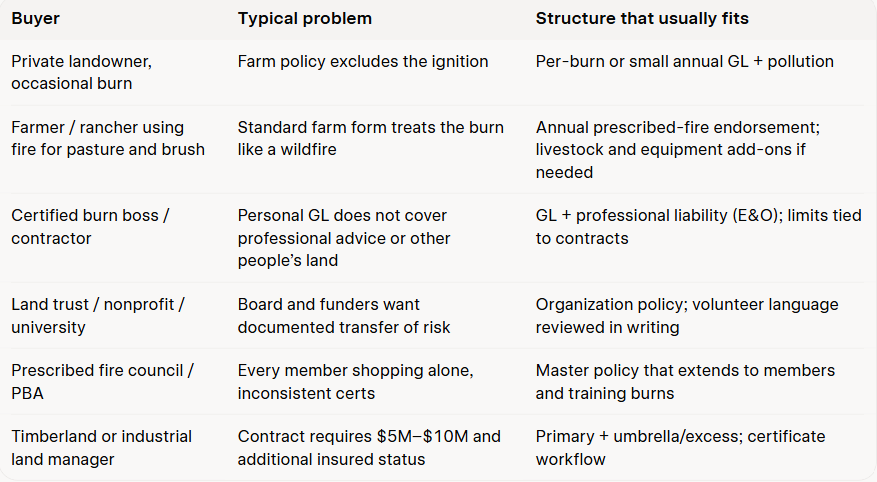
A council master policy is one of the highest-leverage options Conservation United writes. It removes the “each crew finds its own market” problem and usually prices better than a stack of individual policies.
What underwriters actually look at
Expect questions in this order. Having answers ready shortens the quote:
-
Who is the named insured — landowner, contractor, council, or all three?
-
States and counties of operation
-
Acres per year and number of burn days
-
Who writes the prescription and who is on the line as burn boss
-
Training, qualifications, and whether a certified or carded boss is required in that state
-
Holding resources, adjoining values (homes, crops, timber, highways, transmission)
-
Smoke-management plan and nearest sensitive receptors
-
Required limits and additional-insured wording (agencies and timber companies are specific)
-
Prior losses, including smoke complaints, not just escaped fire
-
Whether volunteers, family labor, or partner crews will be on the unit
If you cannot name the burn boss and the prescription author, the application is not ready. That is not bureaucracy. That is how this class is priced.
A pre-burn insurance checklist (use this the week before the window)
-
Confirm the policy period covers the ignition date and any mop-up days.
-
Confirm the location is scheduled or falls inside the policy territory.
-
Request the certificate before the permit office closes, with the exact additional-insured and waiver language the agency or landowner specified.
-
Keep the written burn plan, weather forecast, and notification log with the policy file. Defense counsel will ask for them.
-
If volunteers or partner crews are present, confirm they are either insured elsewhere or added correctly. Do not assume “they showed up with a shirt” equals coverage.
-
Photograph control lines and adjoining values before ignition. It is cheap evidence.
-
Know the claim-reporting number before you strike the first fusee. Escape claims are time-sensitive.
Conservation United’s operational edge is not a slogan. Burn windows collapse. A certificate that arrives three days after the RH dropped is a burned opportunity, not a service success.
How this interacts with grants, timber contracts, and lenders
NRCS EQIP and CSP files, state cost-share, and some carbon or habitat programs now ask whether the practice is insured. They are not asking whether you have a homeowner’s policy. They are asking whether the ignition itself is covered.
Timberland access agreements (the Weyerhaeuser-style requirement is the example Conservation United has cited publicly) often demand umbrella limits up to $10 million and additional-insured status. A $1 million farm endorsement will not clear that desk.
Lenders financing brush management or pasture renovation sometimes make the same request. Proof of prescribed-fire liability is becoming part of the project file, the same way a contractor’s GL cert is part of a construction file.
How to request a usable quote
Call (855) 570-2797 or use the request-a-quote form.
Send, in one email:
-
Entity name and years in operation
-
States
-
Annual acres and burn-day estimate
-
Who needs to be named (owner, boss, council)
-
Limit and additional-insured requirements
-
Whether you need workers’ comp, auto, or equipment
-
Desired effective date
Same-day quotes are the stated standard when the application is complete. Incomplete applications are what turn “same day” into “after the cold front.”
Bottom line
Prescribed fire is a land-management tool. Standard insurance treats it like a wildfire. Until that changes across the ordinary farm and GL market, practitioners need a form that names the activity, drops the hostile-fire exclusion, and attaches pollution and professional coverage on purpose.
Conservation United is one of the few nationwide brokerages that treats that form as a core product rather than an exception. State pools and association risk-sharing are expanding in 2026, and they should be used where they fit. They do not replace a portable commercial policy for multi-state work, high-limit contracts, or organizations that need certificates on short notice.
If fire is in the management plan, the insurance conversation belongs in the same folder as the burn plan — not in the claim file after the wind shifts.