The Agency Insurance Myth: Why Friends Groups Need Their Own Policy — and How Conservation United Builds It Around Park Work
Most Friends Groups discover they need insurance the same way they discover a washed-out culvert: after the work is already underway. A superintendent asks for a certificate of insurance before a 5K. A grantor wants proof of directors and officers coverage. A volunteer twists an ankle on a root-ripping day and the board learns workers’ compensation does not apply to unpaid labor. Or someone finally reads the memorandum of understanding and finds an indemnification clause that runs only one direction — toward the agency.
Here is the sentence that belongs at the top of every Friends Group board packet: the park agency’s insurance does not cover your organization. Individual volunteer agreements, county volunteer policies, and the federal Volunteer Protection Act protect people in narrow ways. They do not defend the 501(c)(3), its bank account, or its board when a claim names the Friends Group as the defendant.
That is the problem Conservation United built Friends Group Insurance to solve. This is a working map: what Friends Groups actually do, where the liability lives, which policy answers which risk, and how to brief a board before the next volunteer Saturday.
What Friends Groups actually do — and why a standard nonprofit policy fails
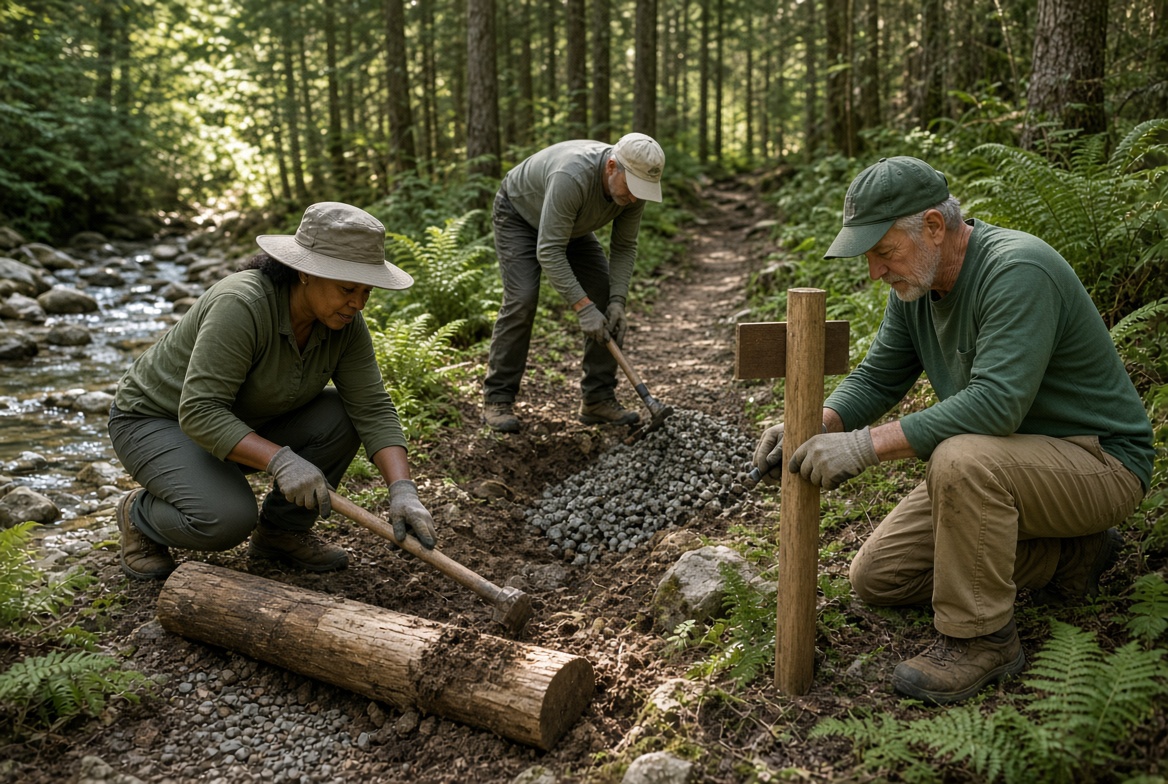
Friends Groups exist because public land agencies cannot do everything parks need. They recruit and deploy volunteers. They raise money the agency cannot. They help manage resources — invasive plants, trails, historic structures, visitor centers, nature stores. They publicize threats to habitat, funding, and access. Those four functions are why parks stay open. They are also four different risk profiles that a generic “nonprofit package” was never designed to underwrite.
The scale of the work is easy to underestimate:
-
National park partners contributed more than $500 million in direct and indirect aid to national parks in 2023 (National Park Foundation, Park Partners Report). Friends Groups were a core slice of that support.
-
Park nonprofits and volunteers accounted for about $1.2 billion of local park investment in 2024 across the 100 most populous U.S. cities — up 26 percent from 2019 (Trust for Public Land, City Park Facts).
-
Independent Sector’s 2026 Value of Volunteer Time report prices a U.S. volunteer hour at $36.14. A group that logs 8,000 field hours is putting roughly $289,000 of labor into a park — labor the agency did not buy, and labor the Friends Group is expected to supervise safely.
-
Parks & Trails New York survey data shows Friends Groups hosting dozens of programs a year and raising millions collectively, often on annual budgets under $10,000.
Small budget, large public footprint. That combination is why a $1 million liability limit and a volunteer accident policy are not “nice to have.” They are how a group with a thin reserve survives one claim.
The four coverage gaps standard policies leave open
Generic nonprofit insurance is written for office-based charities. Friends Groups operate in mud, on trails, around power tools, next to visitors, and under public-agency contracts.
1. Volunteers are not employees.
Workers’ compensation covers paid staff. It does not cover the retired botanist pulling garlic mustard or the board treasurer who strains a shoulder loading a trailer. General liability may defend the organization if that volunteer later sues. It does not pay the urgent-care bill. Volunteer Accident Insurance exists for that gap — medical reimbursement for unpaid people injured while doing the group’s work. Conservation United treats this as a core line. Prior program details have included field-injury medical limits and entry points starting in the low hundreds of dollars a year for smaller groups.
2. Habitat work is not an office errand.
Invasive removal, streambank planting, trail construction, and prescribed fire carry pollution, property-damage, and “your work” exposures that a standard CGL form often excludes. Herbicide overspray, sediment leaving a site, or smoke from a cooperative burn is not a slip-and-fall. Conservation United underwrites pollution liability and, where needed, prescribed-fire coverage — a line most generalist brokers will not quote because they do not read burn plans or agency partnerships.
3. Boards make contested decisions.
Friends Groups decide which projects to fund, which vendors to hire, how to describe a campaign, whether to take a public position, and how to handle a volunteer who should no longer be on site. Those are D&O exposures. Homeowners policies and the Volunteer Protection Act do not cover alleged breach of fiduciary duty or defense costs for the organization itself.
4. The agency will ask you to indemnify it.
NPS partner handbooks, U.S. Fish and Wildlife Service Friends Partnership Agreements, state DNR special-use permits, and county park MOUs routinely require the Friends Group to carry liability insurance, name the agency as additional insured, and indemnify the agency. Fairfax County materials have stated that groups are not covered by the county volunteer insurance policy. Coalition of Refuge Friends and Advocates guidance is equally direct: the Service Volunteer Agreement does not protect the Friends organization from claims. If your only “coverage” is the park’s, you cannot produce the certificate the permit requires.
What belongs in a Conservation United Friends Group package
Conservation United is a specialty brokerage founded by people who have done trail work, restoration, and park stewardship. The Friends Group program typically layers:
-
General liability — bodily injury, property damage, and personal injury from events, work days, and public programs. This is the policy that produces the COI the park or city risk manager will request, usually $1 million per occurrence, with the agency named as additional insured and a waiver of subrogation when the MOU requires it.
-
Pollution liability — the environmental-incident gap around habitat work, cleanup, and chemical or sediment releases. If the group touches soil, water, or fire, ask for this line by name.
-
Volunteer accident insurance — medical costs when an unpaid helper is hurt doing the group’s work.
-
Directors and officers liability — defense and indemnity for alleged wrongful acts. Look for employment practices liability, a duty to advance defense costs, and a definition of “insured” that includes committee chairs, not only officers on the secretary of state filing.
-
Property and commercial auto — tools, trailers, inventory, storage, owned vehicles, and hired/non-owned auto even if the group owns no cars. Volunteer personal vehicles are how most groups reach the trailhead.
-
Umbrella, surety, and project-specific options — extra limit for capital or construction work, surety bonds for contracted trail or facility jobs, financial assurance for mitigation banking, and prescribed-fire liability for cooperative burns. Conservation United already serves that market nationwide, including through its partnership with the Society for Ecological Restoration.
Five misconceptions that keep groups underinsured
“The park covers us.”
It covers the park. Volunteer agreements cover individual volunteers in limited circumstances. They do not name your corporation or satisfy an additional-insured requirement in your own MOU. If you cannot produce a certificate with your legal name on it, you are not covered.
“The Volunteer Protection Act is enough.”
The VPA of 1997 can shield individual volunteers from simple negligence when they act within scope and are paid no more than $500 a year. It does not protect the organization. It does not cover gross negligence, motor vehicles, or civil-rights claims. It is not a substitute for GL or D&O.
“We’ll just buy a special-event policy for the 5K.”
A one-day policy can fill a permit. It does not cover next Saturday’s invasive-species workday, the nature store, the board meeting that awards a contract, or the volunteer injured loading leftover race barriers on Monday. Event policies are a patch. Friends Group Insurance is the operating system.
“We have no employees, so we have no risk.”
Most Friends Group claims do not start with payroll. They start with a visitor, a volunteer, a neighbor, a vendor, or a fellow board member. No employees often means no workers’ compensation — which is why volunteer accident coverage becomes more important, not less.
“Insurance is too expensive for a group our size.”
Coalition of Refuge Friends guidance has long put combination GL and property packages for community Friends Groups around $1,000 a year, with volunteer accident priced by headcount and D&O for a small volunteer board often starting in the mid-hundreds. Ask Conservation United for a Friends Group quote, not a generic 501(c)(3) quote.
Board packet checklist for this quarter
-
Legal name and status. Insured name must match the determination letter and the MOU. DBA mismatches kill certificates.
-
Activity schedule. Recurring workdays, public events, store/visitor-center shifts, youth programs, herbicides, power tools, watercraft, fire.
-
MOU and permit language. Additional insured, waiver of subrogation, primary-and-noncontributory, indemnification. Send the pages before you bind.
-
Volunteer practices. Waivers, sign-in sheets, age minimums, tool training, heat/weather cutoff, incident reporting.
-
Who drives. Owned autos, rented vans, personal vehicles hauling tools or people.
-
What you own. Tools, trailers, tents, POS equipment, inventory, signs. Photograph and schedule it.
-
Who sits on the board. Minutes and a conflict-of-interest policy are part of the D&O file.
-
Data you hold. Donor lists, member emails, event registration, card processing.
-
Certificate workflow. Know how fast you can get a COI when an agency gives you 10 days’ notice.
-
Annual review date. Sixty days before renewal. Add mid-term programs in writing so they are not “undisclosed.”
How to start
Gather four things: the latest MOU or special-use permit; a one-page activity list; volunteer/staff/vehicle/equipment basics; and the last certificate language the agency requested. Then request a quote at conservationinsurance.com/request-quote and ask specifically for Friends Group Insurance.
Parks will keep needing Friends Groups. Volunteer hours will keep being worth more than $36 an hour on paper and priceless on the ground. The groups that last treat insurance as part of stewardship — the same discipline they already bring to trail design, fundraising ethics, and habitat work.
Protect the people protecting the park.


